Questions to Ask Before Adult Growth Hormone Testing
The words “GH test” do not tell you which question an appointment is meant to answer. Stimulation and suppression look at different responses. Understanding that distinction helps you ask about the proposed assessment without trying to choose or interpret a test yourself.
On this page
- Ask why testing is being considered in your history
- Stimulation and suppression ask different questions
- Name the question before discussing the appointment
- An unclear appointment letter needs clarification
- Link the result to a possible next decision
- The clinic chooses and interprets the assessment
- Sources and reading context
Ask why testing is being considered in your history
The Pituitary Society describes adult evaluation in the context of clinical history, including pituitary disease and relevant previous treatment or injury. Tiredness alone should not be turned into a diagnosis or an automatic request for GH testing. A useful opening question is: “Which part of my history makes this assessment relevant?” Bring known records and dates; the clinician determines their significance. [1]
For the wider assessment context behind suspected GH deficiency, read HGHThai’s guide to growth hormone deficiency assessment
If the reason for assessment remains unclear, name the uncertainty in an adult GH assessment so the next question distinguishes missing records from interpretation.
Stimulation and suppression ask different questions
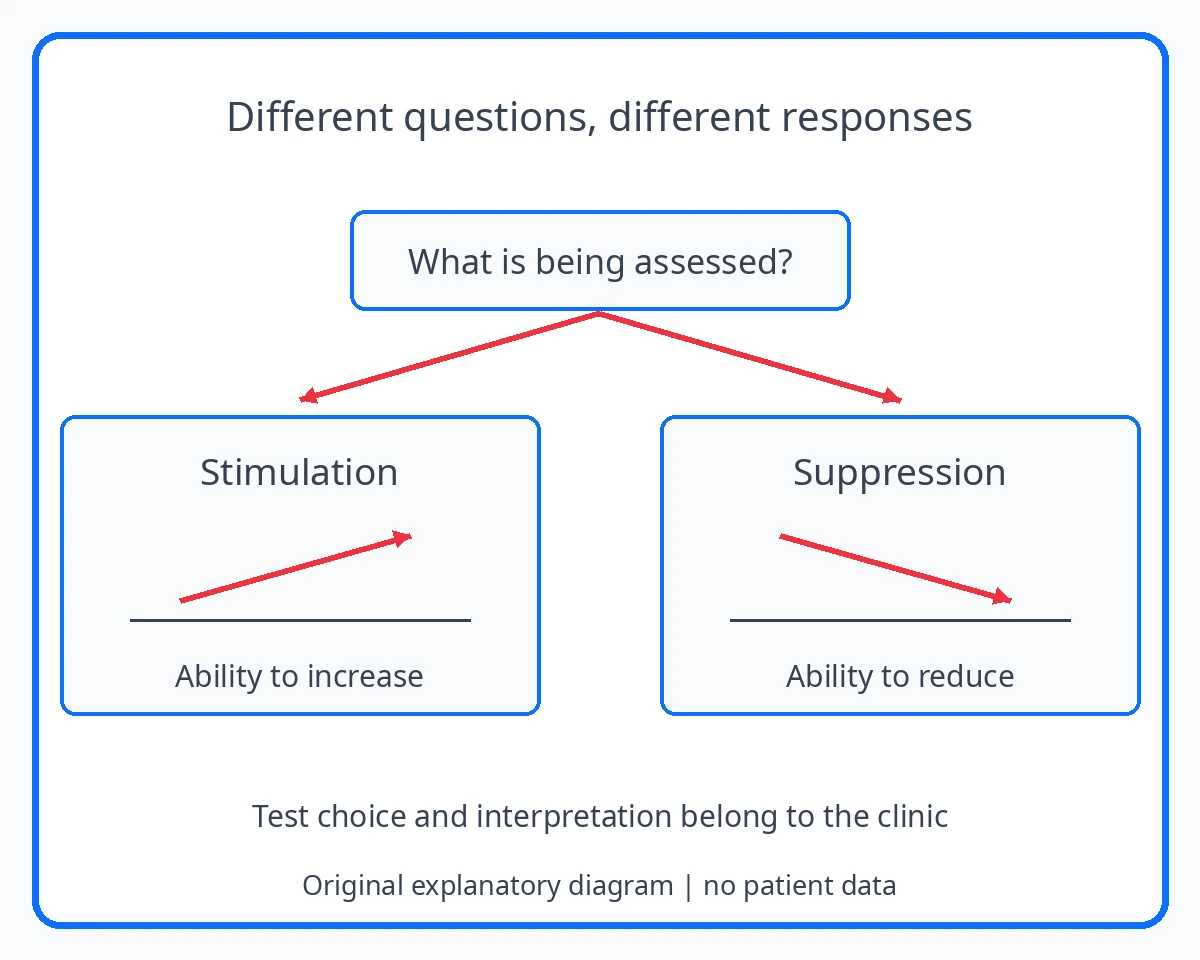
MedlinePlus describes stimulation testing as assessing whether GH rises after a planned stimulus, and suppression testing as assessing whether it falls under the relevant test conditions. The first helps investigate insufficient secretion; the second helps investigate excess. They are not stronger and weaker versions of the same assessment.
Dynamic testing uses a sequence of samples under a defined protocol. A baseline value is one part of that sequence, not the whole answer. The arrows in the diagram represent the direction being investigated; they are not a model of an individual patient’s curve, a diagnostic threshold or a promise that every response looks the same. [2]
Name the question before discussing the appointment
These are reading distinctions, not instructions to request a particular test.
| Term | Question being investigated | Useful question for the clinic |
|---|---|---|
| Stimulation | Can secretion increase in response to the planned stimulus? | Why is this response relevant to my history? |
| Suppression | Is secretion reduced under the relevant test conditions? | Which concern is this assessment investigating? |
| Serial samples | How does the response develop during the protocol? | Who will explain the complete result? |
| Preparation | The instructions for this exact appointment | Which instructions apply to my medicines and circumstances? |
An unclear appointment letter needs clarification
A fictional letter says only “dynamic endocrine test”. The patient asks the service to confirm the full test name, clinical purpose and current preparation instructions, then keeps that reply with the letter.
That resolves the administrative uncertainty without asking the patient to select a test. If the clinician later explains that an earlier result does not answer the referral question, the next useful question is what information the planned response test adds.
For the difference between a snapshot and a response series, read Why a Random Growth Hormone Blood Result Needs Context
Link the result to a possible next decision
Ask what a clear, uncertain or unexpected result would change in your care. Also tell the team about relevant medical history and current medicines so it can choose and prepare the assessment appropriately. The Pituitary Society notes that test selection depends on individual factors. Keep the team’s preparation instructions with the appointment details instead of borrowing instructions from a different hospital’s test leaflet. [1]
Once the test is agreed, organize the visit using Planning a Growth Hormone Stimulation Test Visit With Your Clinic
To make the medicine discussion specific, prepare a current medication list and leave any disagreement between old and current instructions visible.
The clinic chooses and interprets the assessment
This guide does not select a test, provide a protocol or set diagnostic thresholds. Individual test choice and preparation belong to the clinical service.
Sources and reading context
- Pituitary Society growth hormone deficiency patient booklet — Patient education, adult history/testing and prescribed-care follow-up; not an individualized protocol
- MedlinePlus growth hormone tests — Use pulsatile secretion and purpose only; inconsistent stimulation/suppression wording in results excluded