What Information Helps an Adult Pituitary Referral
“The records were sent” is a useful update, but it does not confirm that the receiving clinic can read them. A referral packet needs a clear clinical question and a simple way to see which documents are available, which are in transit and which are still missing.
On this page
- Put the clinical question at the centre
- Connect documents to the events they describe
- Three documents, three different next actions
- The missing piece is not always another test
- Track a document through more than one status
- The receiving service decides what the referral requires
- Sources and reading context
Put the clinical question at the centre
Sinai Health’s referral information illustrates the role of identifying and contact details and a stated reason for referral. Its requirements belong to that service, and disease-specific items should not be transferred to every pituitary referral. In your own record, keep the referral question visible: what is the referring clinician asking the specialist to assess? If you do not have the wording, request clarification rather than writing a diagnosis yourself. [1]
Connect documents to the events they describe
The Pituitary Society describes the relevance of adult pituitary history when considering GH assessment. Arrange existing reports around dated events such as prior pituitary care, relevant procedures and earlier assessments. This does not mean every referral requires every possible test. Ask which already-existing documents the receiving service needs and whether the referring team has sent them. A document list should reveal gaps, not become an instruction to order new investigations. [3]
Three documents, three different next actions
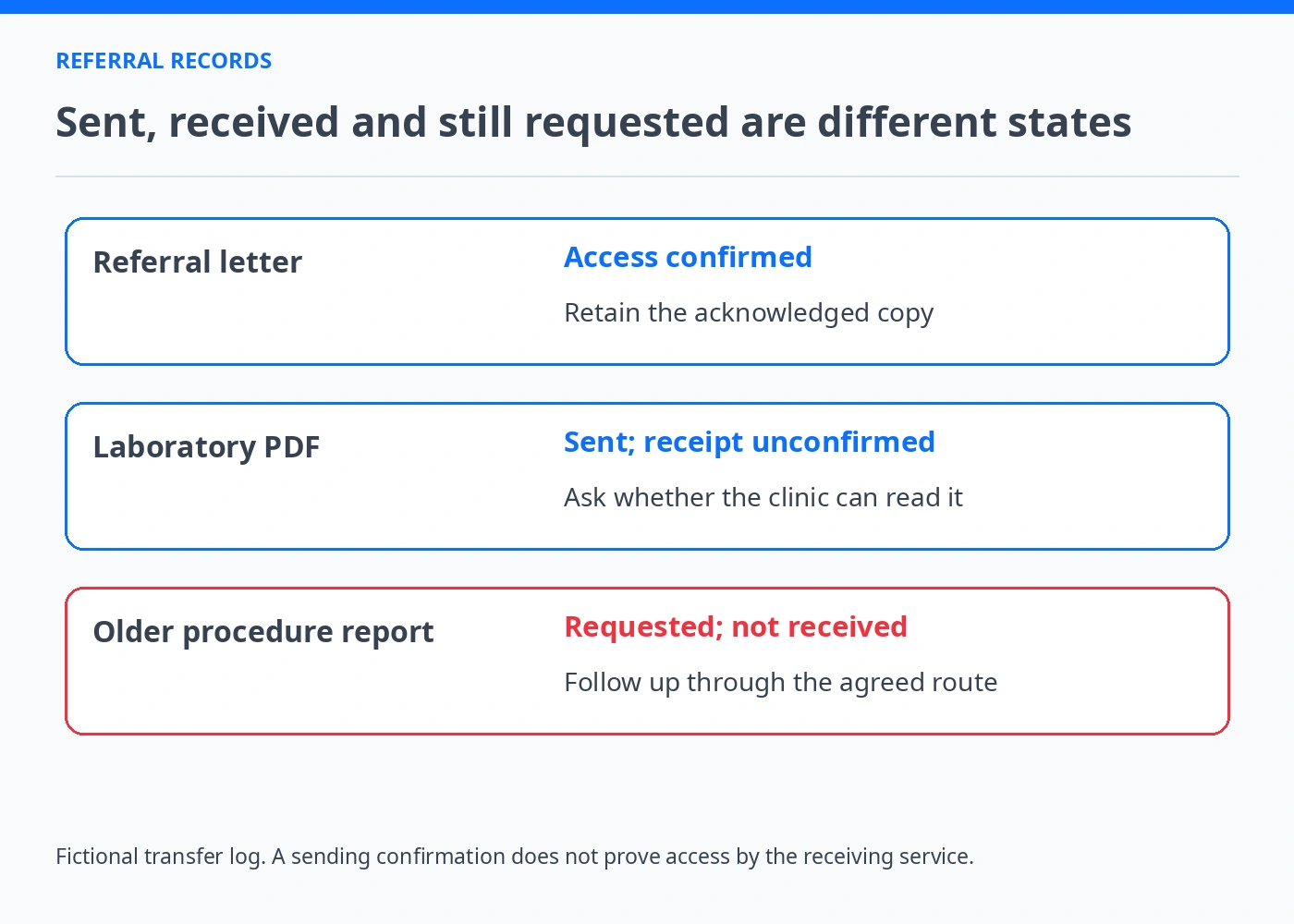
This is a fictional transfer log, not a universal referral checklist.
| Document | Recorded status | Next action |
|---|---|---|
| Referral letter, 3 October | Receiving clinic confirmed access on 9 October | Keep the acknowledged copy |
| Laboratory PDF, specimen 6 October | Sent on 9 October; receipt not confirmed | Ask whether the receiving team can access it |
| Procedure report from 2021 | Requested from the previous service on 8 October | Follow up on the request through the agreed route |
The missing piece is not always another test
The receiving service asks for the older procedure report. The patient’s log shows that it has been requested but has not arrived. That is a document-transfer task, not evidence that the procedure must be repeated or that a new investigation is automatically needed.
Once the report arrives, keep the event date distinct from the date it was received. Link it to the referral question and update the receiving clinic’s access status after confirmation.
To index the reports without losing their origin, use Organizing Laboratory Results for a Pituitary Appointment
Track a document through more than one status
Use distinct labels such as requested, sent and receipt/access confirmed. A sending confirmation establishes one event; confirmation from the receiving service establishes another. Record the date and contact next to each status. If an attachment is unreadable, preserve that as an access problem rather than calling the document absent.
The fictional packet in this example has a referral letter that can be read, a laboratory report sent but not yet confirmed, and an older procedure report still requested. The next actions differ. Resending every file or marking the whole packet complete would conceal those differences. Current medicine and clinician lists can accompany the packet, as Sinai’s first-visit guidance illustrates. [2]
For unfamiliar fields within a laboratory attachment, see Reading an IGF-1 Blood Test Report: A Patient Worksheet
The receiving service decides what the referral requires
The referring clinician and receiving service determine clinical content and acceptance requirements. This worksheet does not establish access, urgency or the investigations required for a referral.
Sources and reading context
- Sinai Health referral information — Example referral service only; do not transfer diabetes-specific requirements to pituitary care
- Sinai Health general endocrinology clinic — Example clinic information, not universal access or referral requirements
- Pituitary Society growth hormone deficiency patient booklet — Patient education, adult history/testing and prescribed-care follow-up; not an individualized protocol