A Symptom Diary for an Endocrine Appointment: What to Record
“I was exhausted” may describe the feeling accurately, but a clinician also needs to know what changed in your day. A useful symptom diary records an event, its effect and the surrounding circumstances. It leaves the cause open for discussion instead of naming a hormone disorder in every entry.
On this page
- Describe an event that another person could understand
- Keep observation apart from interpretation
- Three days, with uncertainty left visible
- A useful summary stays close to the notes
- Summarise a pattern without filling the gaps
- A diary supports assessment; it cannot determine the cause
- Sources and reading context
Describe an event that another person could understand
HealthLink BC recommends preparing symptom details and questions for medical visits. For each entry, record onset, duration, circumstances and impact. “Needed to rest halfway through my usual walk” communicates something different from “low energy.” Add whether the experience is new, recurring or changing. Use your own words, and note when you are uncertain about the date rather than inventing precision. [1]
Keep observation apart from interpretation
Fatigue can appear in discussions of adult GH deficiency, but it is not specific enough to establish that diagnosis. MedlinePlus describes IGF-1 testing within a broader clinical assessment. In the diary, separate “what I noticed” from “what I wonder it means.” That allows you to raise a hormone concern without turning it into the assumed explanation for every entry. It also makes room for sleep, illness and other relevant context. [2]
Three days, with uncertainty left visible
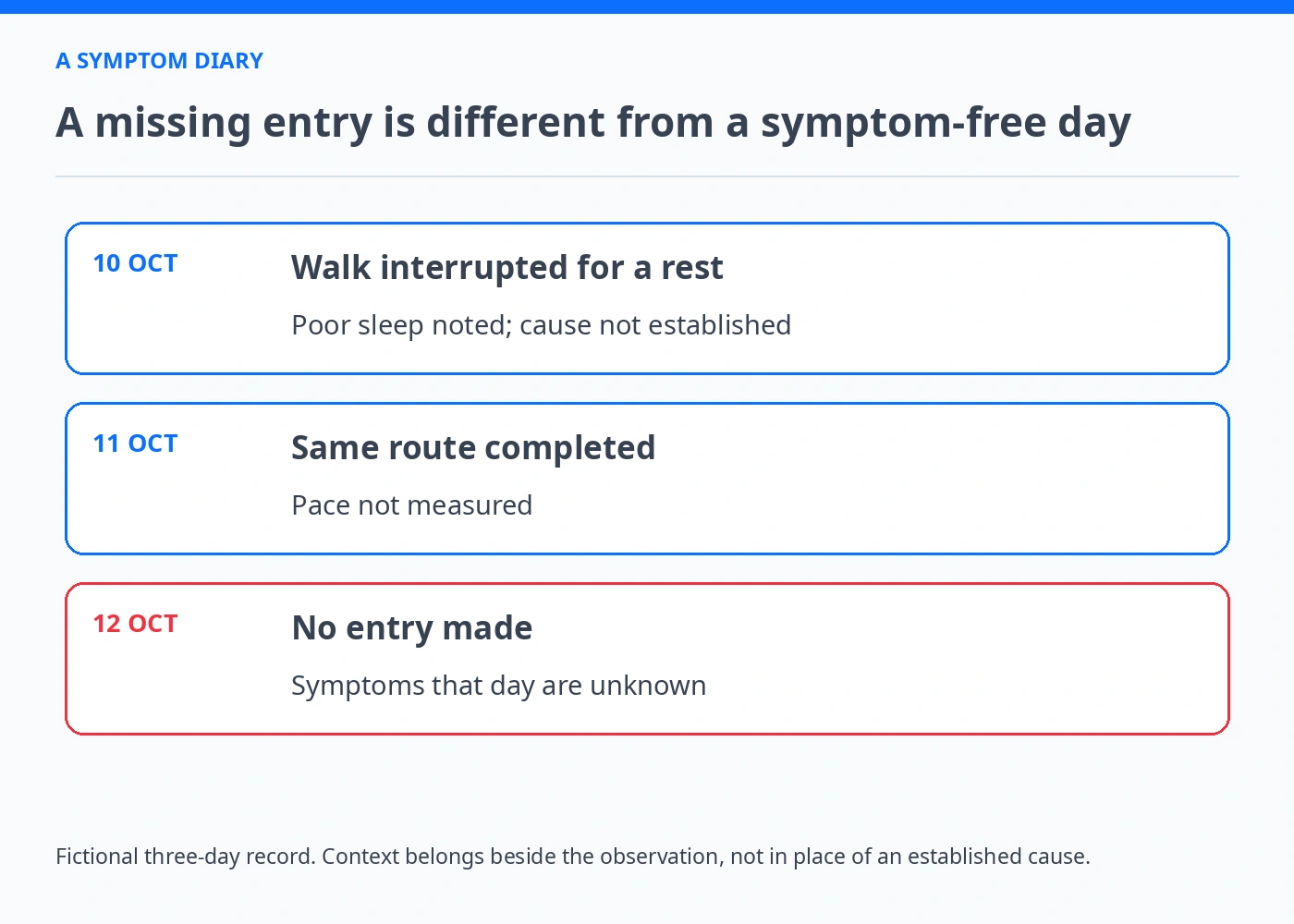
These entries are invented to demonstrate observation, context and missing data.
| Date | Observation and daily effect | Context or limitation |
|---|---|---|
| 10 October, afternoon | Stopped halfway through the usual walk to rest | Slept poorly the previous night; duration of rest not recorded |
| 11 October, afternoon | Completed the same route without stopping | Different pace possible; not timed |
| 12 October | No entry made | No conclusion about symptoms that day |
A useful summary stays close to the notes
“I had to stop on one walk and completed the next. I had slept poorly before the first, but I do not know whether that explains it.” This gives the clinician a concrete change and an honest uncertainty.
“My hormones crashed for three days” would add both a cause and a duration that the diary does not establish. You can still raise a hormone concern; put it in the questions column rather than presenting it as an observed fact.
When appetite or illness changed near a blood test, see Nutrition, Illness, and IGF-1: Context to Bring to an Appointment
Summarise a pattern without filling the gaps
Three short entries can be easier to discuss than a page of repeated severity scores. Record a specific task, what happened during it and any context you actually know. Use the same wording for comparable activities where possible. If you did not make an entry on a day, mark it as unrecorded rather than treating it as symptom-free.
At the appointment, say what the notes show and what they cannot show. In the fictional sequence in this article, a walk was interrupted once, completed the next day, and not recorded on the third. Poor sleep accompanies the first event, but these notes cannot establish that sleep—or a hormone change—caused it.
To bring the diary into a first visit, combine it with Preparing for a First Adult Pituitary Appointment
A diary supports assessment; it cannot determine the cause
A diary cannot diagnose GH deficiency or determine whether testing is needed. Do not wait to finish a record before seeking help for severe or rapidly worsening symptoms.
Sources and reading context
- HealthLink BC working with your doctor — Describe symptoms and daily effects; not a diagnostic instrument
- MedlinePlus IGF-1 test — Test-purpose and contextual interpretation; not a diagnosis from one result