Organizing Laboratory Results for a Pituitary Appointment
A lab result is easier to discuss when you can open the original report in seconds. A short index should point to that source and keep the specimen date, report date and version separate. Otherwise, a later amendment can look like a new blood test or an old screenshot can look current.
On this page
Keep the original and create a separate index
Reference intervals, units and laboratory identity matter when reading results, as MedlinePlus explains. Save the original report in a stable format and give it a descriptive filename that avoids exposing sensitive details unnecessarily. In a separate index, record the analyte, specimen date, laboratory and file location. This lets you find a report quickly without relying on a cropped screenshot or a copied number. [1]
Do not let an amended report create a false extra sample
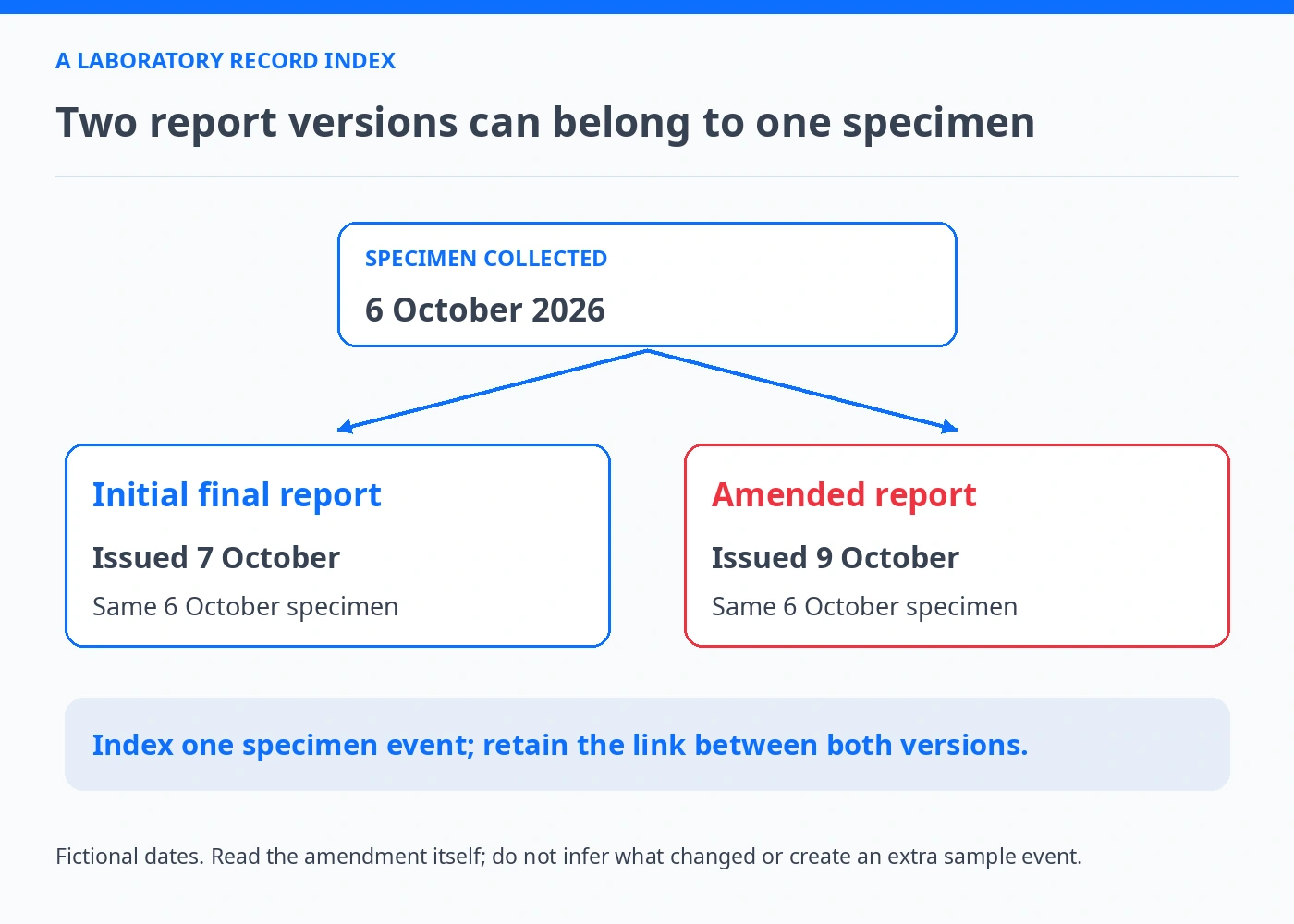
A specimen date identifies when a sample was taken; a report date identifies when information was issued. In the fictional example below, a final report and an amended report both refer to the sample collected on 6 October. Filing them as two separate sample events would distort the history.
Keep both files with explicit version labels, and link the amendment to the earlier report. Do not assume what changed—read and retain the amendment’s own wording. An index row can record the relationship without interpreting the result or silently overwriting an earlier file.
One specimen, two report versions
Invented dates and filenames demonstrate filing. No laboratory value or clinical conclusion is implied.
| Record | Specimen / report dates | File and relationship |
|---|---|---|
| Initial final report | Specimen: 6 Oct 2026; issued: 7 Oct | 2026-10-06_labA_IGF1_final.pdf |
| Amended report | Same specimen: 6 Oct; amended: 9 Oct | 2026-10-06_labA_IGF1_amended-2026-10-09.pdf; linked to the earlier version |
| Appointment index | One specimen event with two versions | Open the amended report and retain the earlier file as history |
Keep the source comment with the number
A portal summary shows a value, but the full PDF also contains its unit, interval and a comment. Link the index to that PDF rather than making the cropped summary your only source. If a later version arrives, add the relationship shown above.
When a laboratory changes, record the new laboratory in the index instead of smoothing the transition into one continuous-looking series. A tidy folder should make a comparison question easier to notice, not hide it.
Build a short appointment view
Select the reports relevant to the referral question and list any gaps to discuss. Keep the full folder available in case the clinician needs earlier information. Sinai’s first-visit guidance emphasizes history and current care, so the folder works best alongside your medication and clinician lists. If a laboratory or method changes, mark that transition and leave interpretation to the review. A neat index should preserve uncertainty as clearly as it preserves dates. [2] [1]
Use the index as an attachment to Preparing for a First Adult Pituitary Appointment
For the separate task of understanding a series over time, see Reading a Hormone Test Trend Without Diagnosing Yourself
A filing method does not interpret a trend
This guide organizes information rather than interpreting trends. Store medical files privately and use the service’s appropriate channel when sharing them.
Sources and reading context
- MedlinePlus understanding laboratory results — Reference intervals, units and contextual interpretation; no personal diagnosis
- Sinai Health general endocrinology clinic — Example clinic information, not universal access or referral requirements