An Adult Endocrine Follow-Up Checklist for Shared Decisions
An endocrine follow-up can end with a useful plan even when no treatment decision is made that day. What matters is whether you understand the question, the options discussed and the next person responsible for moving the plan forward.
On this page
- Describe the goal before the intervention
- Compare benefits, downsides and uncertainty
- A deferred decision with a concrete next step
- Read back the plan, including what has not been decided
- Give a deferred decision an owner and a next contact
- The action record supports the discussion; it does not choose treatment
- Sources and reading context
Describe the goal before the intervention
AHRQ’s SHARE approach emphasizes patient values alongside evidence about options. A daily-life goal, such as understanding the cause of an activity limitation, is different from a proposed test or treatment. The test is a possible means of addressing a question; it is not the goal by itself. State your priority in ordinary language so the clinician can explain how each option relates to it. [1]
Compare benefits, downsides and uncertainty
For each option discussed, note what it is intended to achieve, what remains uncertain and what burdens or unwanted effects matter to you. Include practical issues such as appointments or the ability to follow the plan. Shared decision-making does not require pretending all options are equal. It requires understanding the relevant choices and why one may fit your clinical situation and preferences better. Ask for clarification when a term is unfamiliar. [1]
A deferred decision with a concrete next step
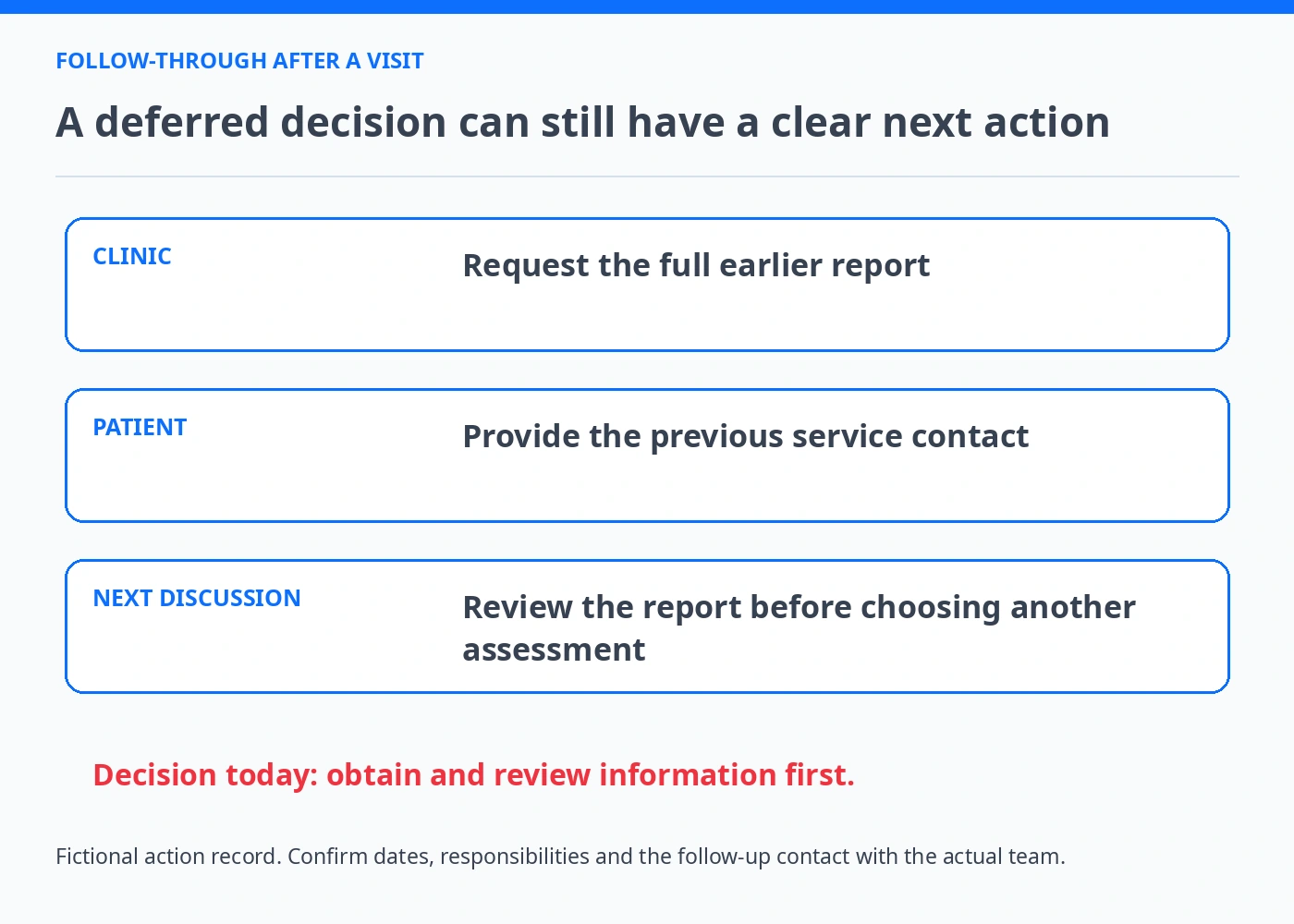
This fictional action record illustrates responsibility and follow-through. It is not a timetable for real clinical care.
| Part of the plan | Illustrative agreement | Owner or trigger |
|---|---|---|
| Patient priority | Understand the change in usual activity before choosing the next assessment | Patient explains daily-life impact |
| Decision today | Review the existing report before deciding on another assessment | Clinical team |
| Information task | Request the full earlier report; patient supplies service contact | Clinic requests; patient provides contact details |
| Next discussion | Review call after the report is received and read | Clinic confirms arrangement |
| If no update arrives | If no update has arrived by 20 October, phone the clinic number on the appointment letter | Patient; fictional date and agreed channel for this example |
Read back the plan, including what has not been decided
“We have not chosen another assessment today. Your team will request the report, I will send the previous service’s contact, and we will discuss the findings after you have reviewed it. If I have no update by 20 October, I will phone the clinic number on my appointment letter.”
This preserves an active plan without suggesting that a treatment has been selected. If the next discussion produces several reasonable options, return to their expected benefits, downsides, uncertainty and the daily-life priorities that matter to you.
When an important uncertainty remains after discussion, review Seeking an Endocrine Second Opinion: Organizing Your Questions and Records
For examples of why endocrine goals include daily function and treatment burden, see HGHThai’s discussion of coordinated endocrine follow-up
Give a deferred decision an owner and a next contact
AHRQ encourages patients to understand instructions and follow-up. If a decision is deferred, record what information is missing, who will obtain it and how the next discussion will happen. Ask what to do if the agreed communication does not arrive. “Wait for results” leaves those responsibilities unclear.
Read the plan back in ordinary language. In this fictional example, the patient is not waiting passively: the clinic requests a report, the patient supplies the previous service’s contact, and a review call is planned after receipt. The exact dates and contact route should come from the actual team, not from an online template. [2]
If the discussion concerns changing laboratory results, bring the context described in Reading a Hormone Test Trend Without Diagnosing Yourself
The action record supports the discussion; it does not choose treatment
The checklist is an original communication aid, not a validated decision score. It does not recommend GH treatment or promise benefits from any option.
Sources and reading context
- AHRQ SHARE decision-making resources — Benefits, harms and patient priorities; not a treatment recommendation
- AHRQ preparation for healthcare appointments — Organize concerns, questions and medicines for discussion