When an Adult Growth Hormone Diagnosis Is Uncertain: Questions for Follow-Up
“We need more information” can mean several things in an adult GH assessment. An old report may be missing, two measurements may not be directly comparable, or a clinician may need to explain how a complete result fits the history. Those are different problems, with different next steps.
On this page
A single result has limits
The Pituitary Society explains that IGF-1 can be within the reference range in some people with GH deficiency. MedlinePlus also describes other contexts that can contribute to low IGF-1 in adults. These limits work in both directions: an in-range result is not an all-purpose exclusion, and a low result is not a complete diagnosis. The clinician must relate the findings to the reason for testing. [1] [2]
For the narrower task of documenting a low IGF-1 finding, see A Low IGF-1 Result: What Context Your Clinician May Need
Locate the uncertainty before choosing the next task
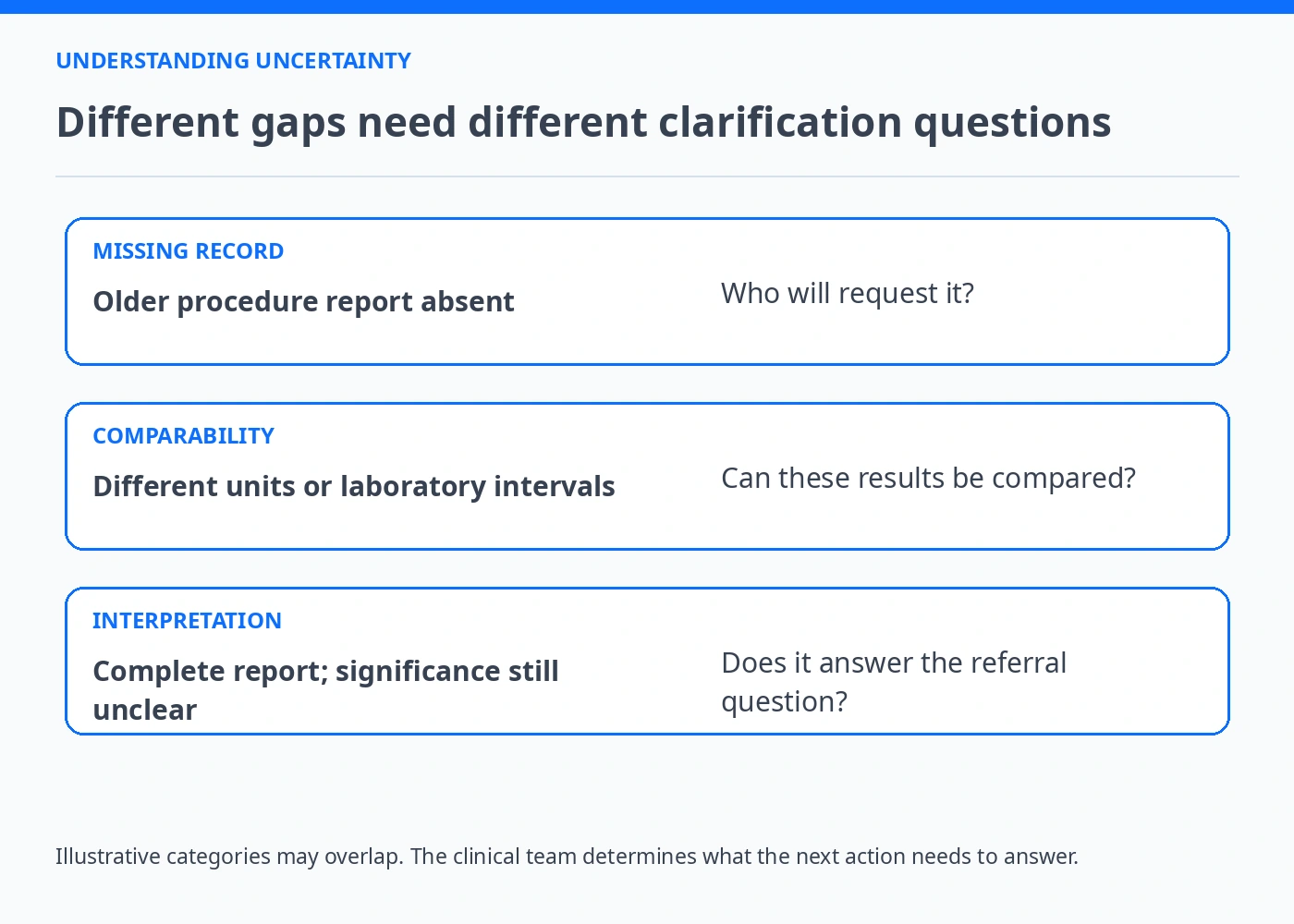
Separate a missing fact from a question about meaning. A missing procedure report may need a records request. Two reports with different units or laboratories may need a comparability review. A complete report can still leave a clinical interpretation question because its result must be considered with the history and purpose of testing.
The table is a way to name the gap in conversation, not a diagnostic algorithm. More than one category can apply at the same time. Ask the team which uncertainty matters to the current decision, and what the proposed next action is expected to resolve. [4]
Three kinds of uncertainty
The situations below are illustrative. The clinical team decides which questions and actions apply.
| Situation | Type of gap | A useful clarification |
|---|---|---|
| Earlier procedure mentioned, but report unavailable | Missing source record | Which service holds it, and who will request it? |
| Results from different laboratories have different units or intervals | Comparability question | Can these results be compared as presented? |
| An IGF-1 report is complete, but its significance in the pituitary history is unclear | Clinical interpretation | Does this answer the referral question, and what remains unresolved? |
An in-range result and an unresolved question can coexist
A fictional patient receives an IGF-1 result within the printed interval after earlier pituitary care. The useful question is not whether the number “looks normal” in isolation, but whether it answers the reason for the assessment.
The clinician may need to explain the history, obtain a missing record or consider a clinically selected assessment. The patient’s note should capture that explanation and its purpose without converting uncertainty into a diagnosis of deficiency.
Ask what would reduce the uncertainty
A follow-up conversation can clarify whether the next action is obtaining records, reviewing comparability or arranging a clinically selected assessment. Ask what each step is expected to answer and who will explain it afterward. AHRQ’s appointment guidance supports making questions and next steps explicit. Write down the answer even if the plan is to review existing evidence first. More testing is not the only possible response to an unanswered question. [3]
If another test is proposed, prepare with Questions to Ask Before Adult Growth Hormone Testing
After the team identifies the next step, record the agreed endocrine follow-up with an owner, timing and a route for questions that remain open.
Uncertainty is a question to clarify, not a diagnosis
This article does not decide whether GH deficiency is present or recommend a test or treatment. Do not use uncertainty as a reason to start hormones without an agreed clinical assessment.
Sources and reading context
- Pituitary Society growth hormone deficiency patient booklet — Patient education, adult history/testing and prescribed-care follow-up; not an individualized protocol
- MedlinePlus IGF-1 test — Test-purpose and contextual interpretation; not a diagnosis from one result
- AHRQ preparation for healthcare appointments — Organize concerns, questions and medicines for discussion
- MedlinePlus understanding laboratory results — Reference intervals, units and contextual interpretation; no personal diagnosis